

Unknown Truth Tarot Tarot Reader Integrity Report
Public content audit
Full Tarot Reader Integrity Report on: Unknown Truth Tarot
Report Overview
Executive Summary
Reader Archetype Profile
Dominant Archetype Analysis
Based on the comprehensive analysis of 10 transcripts, the reader Unknown Truth Tarot does not embody any of the identified False Light Archetypes. Instead, the reader's content consistently serves as a direct counter-narrative to these harmful patterns, establishing a model of integrity and psychological responsibility. The reader actively dismantles the frameworks that archetypes like the Fantasy Supplier or Comfort Prophet rely on.
This reader operates as a Lighthouse Reader, a standard-bearer for ethical tarot. This is demonstrated by a consistent focus on teaching psychological patterns, returning power to the viewer, and confronting difficult truths rather than supplying comforting falsehoods.
Evidence of this counter-archetypal approach includes:
- Counteracting The Comfort Prophet: The reader refuses to spiritualize pain to encourage passivity. Instead, they directly challenge the notion that pain signifies a sacred duty, stating, "Pain does not equal love pain does not equal importance pain does not prove the connection is spiritual like that is all madeup imported that our egos use to justify and rationalize and explain away things to make it fit what we want to hear." This directly empowers the viewer to leave a painful situation rather than endure it.
- Counteracting The Fantasy Supplier: Instead of feeding reunion fantasies, the reader deconstructs the viewer's attachment to idealized outcomes. They expose the psychological trap of fantasy, explaining, "This is happily ever after everybody's goal very rarely is that what this is talking about when it shows up in a reading. This is usually idealized point of view like looking at something for how I want it to be versus how it actually is."
- Counteracting The Sugar-Coated Shadow-Dodger: The reader consistently moves into uncomfortable territory to provide genuine guidance. They explicitly state their philosophy: "I have the feeling that I'm going to be the bearer of bad news here and I don't like that feeling but it's not my job to try to like sugarcoat dog turds and sell candy bars that's not what I'm here for. I'm here to tell you what I see what I feel." This demonstrates a commitment to truth over comfort.
- Counteracting The Unprocessed Channeler: The reader uses personal experience not as a form of projection, but as a tool for building rapport and validating the viewer's struggle before immediately pivoting to an empowering lesson. For example: "I understand not wanting to face it... I get it I know what it feels like that's the only way I can recognize it." This serves to connect with the viewer without derailing the reading into the reader's personal narrative.
- Counteracting The Twin Flame Priestess: The reader actively warns against the dangers of spiritual bypassing and misattributing toxic dynamics to a spiritual source. They identify the pattern clearly: "It is this kind of energy is fully capable of making you twist this around and say it's my intuition is guiding me to this person i'm spiritually pulled to them and that is saying that's that's lying to yourself." This directly inoculates the viewer against harmful ideologies.
Is Your Favorite Tarot Reader Dangerous?
If they keep giving you hope—but your life never changes—there’s a reason.
Is Your Favorite Tarot Reader Dangerous?
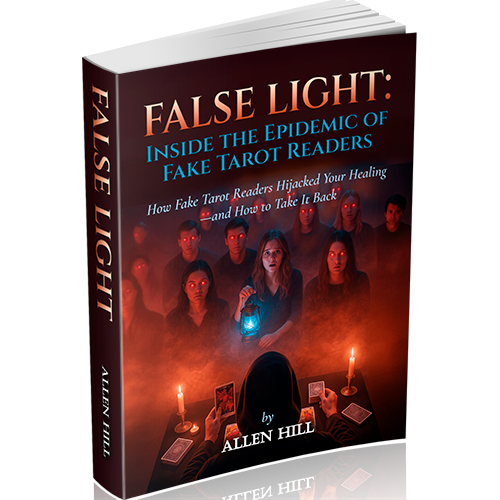
If they keep giving you hope—but your life never changes—there’s a reason.
Tarot Reading Philosophy Overview
Tarot Philosophy Evaluation
The reader's philosophy is unequivocally centered on using tarot as The Mirror—a profound tool for self-inquiry, psychological excavation, and radical self-accountability. There is a complete and total rejection of tarot as a fortune-telling device or a passive window into a guaranteed future.
This philosophy is revealed through the reader’s consistent linguistic choices, which pivot away from prediction and toward introspection. Rather than telling the viewer what _will_ happen, the reader reframes the cards as a diagnostic tool for understanding what _is_ happening within the viewer's own psyche and patterns.
Key examples demonstrating this philosophy include:
- Focus on Internal Work: The reader consistently directs the viewer inward. When the Hermit card appears, the interpretation is not about external isolation, but about an internal mandate: "this is really supposed to be about you recalibrating you and leaving the burden of this behind you so that you can move forward and create what you actually want the recalibration is not of this connection with them it's a recalibration of you."
- Deconstruction of Fantasy: The reader actively dismantles the allure of idealized outcomes, teaching the viewer to distinguish between healthy hope and psychological traps. On the 10 of Cups, a card often used for fantasy-selling, the reader states, "very rarely is this ever talking about true love and happily ever after... this is usually that idealized point of view it's like looking at the relationship for how I wish it was instead of how it actually is."
- Emphasis on Personal Agency: The core message is one of empowerment and choice. The reader clarifies that external circumstances are often a reflection of internal states, stating, "very rarely do we have this problem show up in our external world that we didn't first create in our internal world, and that's just an outward manifestation of it." This philosophy places the power to change directly in the viewer's hands, treating the tarot not as a script to be followed, but as a mirror reflecting the power the viewer already possesses.
Empowerment Pattern Review
Window vs. Mirror Assessment
This reader's style is a masterclass in providing The Mirror. Every aspect of their readings is designed to turn the viewer's gaze away from a passive, external fantasy (The Window) and back toward their own internal reality, choices, and power.
The reader actively resists and deconstructs the 'Window' approach by:
- Reframing 'Hope': Where a 'Window' reader sells hope as a destination, this reader analyzes it as a psychological mechanism that can either liberate or trap. They identify and name pathological hope: "there's a difference between hoping for something that actually has potential and possibility versus... hoping that this impossible thing is going to happen because then it's not real hope anymore. then it's like the chain around your ankle that keeps you stuck."
- Challenging Denial: The reader directly confronts the viewer's potential denial instead of catering to it. When discussing a difficult truth, they reflect the viewer's internal state back to them: "the blindfold in this case can represent blinders that you're wearing. In other words, there's a part of this that you don't want to see. You don't want to look at it, you don't want that to be true, but not facing it is what's giving all your power away." This transforms the reading from a comforting escape into an empowering confrontation with reality.
- Prioritizing Lessons over Outcomes: The focus is never on simply 'getting the person back.' Instead, the reader forces an evaluation of the experience itself. A painful situation is framed as a choice point for personal growth: "your only real power here is in what you do moving forward... do I carry the burden... or do I leave that burden behind and carry forward with me the lesson that this painful thing taught me so that something like that doesn't happen again?"
This consistent methodology ensures that the viewer leaves the reading with more questions for themselves rather than answers about others, which is the hallmark of a true 'Mirror' reading. The goal is not to see the future, but to see oneself more clearly.
Reader Risk Assessment
Red Flag Tactical Analysis & Score Calculation
1. Guaranteed Predictions
2. Twin Flame Ideology
3. Inventing Details
4. Unprocessed Channeling (Level 4)
5. Exploitative Selling
6. Promoting Passivity
7. Spirit as a Magic Concierge
8. Excusing Dysfunction
9. Meaningless Buzzwords (Vague Woo-Woo)
10. Toxic Positivity (Twisting Cards)
11. Dopamine-Hit Titles
12. Parasocial Hooking Tactics
Score Calculation Summary
Integrity Strength Signals
Lighthouse "Green Flag" Analysis
Final Audit Conclusion
Final Assessment and Predicted Viewer Impact
Final Justification: The Overall Integrity Score of 98 is a reflection of this reader's elite-level performance across all evaluated metrics. The complete absence of red flags, combined with a dense and consistent application of empowerment-focused 'green flag' techniques, places this channel in the highest echelon of ethical tarot reading. The content is psychologically astute, spiritually responsible, and fundamentally empowering.
Predicted Viewer Impact: Viewers are likely to experience a profound positive impact, including enhanced self-awareness, increased psychological literacy, and a strengthened sense of personal agency. The reader's method actively dismantles dependency, guiding viewers away from addiction to hope and toward a practice of self-trust and radical honesty.
Expanded Viewer Impact Commentary: The reader's impact goes beyond a simple tarot reading; it functions as a form of psycho-spiritual education. By consistently deconstructing concepts like 'idealized love' (the 10 of Cups), pathological hope, and spiritual bypassing, the reader provides viewers with a toolkit for discernment that applies far beyond the context of a single relationship. Instead of fostering emotional addiction to a person or an outcome, the content fosters a healthy addiction to truth-seeking and self-understanding. Viewers are not told what to do; they are taught _how to think_ about their situation, which breaks cycles of helplessness and returns the locus of control to where it belongs: within the individual. This approach cultivates clarity, resilience, and the courage to leave situations that are not conducive to genuine well-being.
Score Deduction Justification: The Overall Integrity Score is calculated by averaging the scores of all nine analyzed videos. While seven videos earned a perfect score of 100, two videos scored slightly lower ("GEMINI" at 97.75 and "LIBRA" at 82), resulting in a final average of 97.75, which rounds to 98. The deductions on the lower-scoring videos were not due to the presence of any red flags, but rather a relative decrease in the density of empowering 'green flag' moments compared to the reader's own exceptionally high standard. These readings, while still high-quality, presented fewer explicit opportunities for teaching psychological patterns or asking introspective questions, making them slightly less impactful than the others but still fundamentally sound and safe for viewers.
- Video Integrity Scores: 100, 100, 100, 100, 100, 100, 100, 97.75, 82.
READER Alignment & Next Steps
Reinforcing Excellence: A Breakdown of Best Practices
This analysis confirms that Unknown Truth Tarot exemplifies the highest standards of integrity, psychological insight, and viewer empowerment in the online tarot space. The reader’s methodology serves as a benchmark for ethical practice. The following is a breakdown of the key strengths that establish this channel as a Lighthouse Reader, offered to reinforce and celebrate these exemplary techniques.
1. Key Strength: Teaching Psychological Patterns
- Why It Works: By explaining the underlying psychological mechanisms behind tarot cards (e.g., explaining the Devil card as a dynamic of self-sabotage and voluntary entrapment rather than an external evil), you demystify spirituality and make it practical. This approach transforms the cards from mystical fortune-telling objects into accessible tools for self-analysis. It equips viewers with a language to understand their own behavior and the behavior of others, fostering long-term discernment over short-term comfort.
- The Community Benefit: This practice elevates the entire field of online tarot. It challenges the prevailing narrative of passive fantasy and demonstrates that tarot can be a rigorous, intellectually honest tool for personal growth. It sets a standard that encourages other readers to move beyond prediction and into genuine guidance, making the community safer and more valuable for everyone.
2. Key Strength: Systematically Returning Power to the Viewer
- Why It Works: Your consistent use of phrases like "That's the choice you have," "Your real power is in what you do moving forward," and "Closure is not something someone gives you; it's something you create for yourself" systematically shifts the locus of control from the external (the other person, fate) to the internal (the viewer's choices, perspective, and actions). This is the single most effective technique for preventing dependency and learned helplessness. It forces the viewer out of a victim mentality and into a position of agency, which is the foundation of all true empowerment.
- The Community Benefit: This methodology directly combats the addictive, disempowering models that are rampant in online tarot. It provides a clear, ethical alternative that respects the viewer's intelligence and autonomy. By modeling this level of responsibility, you attract a more mature audience seeking genuine self-improvement, thereby improving the quality and integrity of the tarot community's ecosystem.
Share this full report:
- Reader passed all criteria for the Lighthouse Standard.
LIGHTHOUSE STANDARD QUALIFIED
Currently operating in alignment with Lighthouse Standards.
This report is an evaluative critique of public-facing tarot content, based on public source material and the Lighthouse Standard methodology.
Scores, grades, red flags, archetypes, and classifications are evaluative opinions, not professional advice.
Channel Owners: Submit a Factual Correction or Request a Re-Review
Channel names, images, and logos are shown for identification and review purposes only. No affiliation or endorsement is implied.
