
What Is The Lighthouse Standard?
A Plain-English Explanation Of The Viewer-Protection Standard Used In The Tarot Reader Integrity Reports
The Lighthouse Standard is the minimum viewer-protection standard used in the Tarot Reader Integrity Reports.
It doesn’t ask whether a reader is popular.
It doesn’t ask whether they seem gifted.
It doesn’t ask whether their readings feel comforting in the moment.
It asks a more important question:
Does this reader’s guidance help people see clearly, trust themselves, and make grounded choices — or does it pull them deeper into confusion, dependency, and false hope?
That’s the line this standard is built around.
Because when someone is watching tarot from a place of heartbreak, fear, longing, confusion, or spiritual vulnerability, guidance isn’t just entertainment anymore.
It can shape what they believe.
What they tolerate.
What they wait for.
What they excuse.
What they keep hoping is “meant to be.”
And if a reader is going to have that kind of influence, there needs to be a standard.
Not a perfect one.
Not a magical one.
A grounded one.
The Short Version
The Lighthouse Standard is the minimum integrity threshold a tarot reader must meet to be considered viewer-protective inside this directory.
A reader passes the Lighthouse Standard when their public content shows enough grounded, honest, agency-supporting guidance to meet that threshold.
That doesn’t mean they’re perfect.
It doesn’t mean every reading is flawless.
It doesn’t mean you should hand them your power.
It means their content showed enough signs of clarity, restraint, honesty, and viewer protection to avoid falling below the line.
A reader fails the Lighthouse Standard when their content repeatedly shows patterns that may weaken self-trust, encourage emotional dependency, sell false certainty, spiritualize dysfunction, or keep viewers stuck in hope loops.
That’s the heart of the standard.
Does the guidance return power to the viewer, or does it take that power away?
Why The Lighthouse Standard Exists
Online tarot has a trust problem.
Too many readings sound healing on the surface while quietly training people to wait, chase, decode, and doubt themselves.
A reading can feel comforting and still make you less clear.
A reader can sound spiritual and still reinforce a fantasy.
A message can resonate and still pull you away from your own judgment.
That’s why the Lighthouse Standard exists.
It creates a line.
Not because every reader below that line is evil.
Not because every reader above that line is automatically safe.
But because viewers need a way to evaluate more than the vibe.
They need a way to look at the pattern underneath the message.
If a reader is going to influence someone’s hope, heartbreak, choices, spiritual beliefs, and self-trust, there needs to be a minimum standard for how that guidance is handled.
The Lighthouse Standard is that minimum line.
What The Standard Looks For
The Lighthouse Standard looks at repeated patterns in a reader’s public content.
Not one awkward sentence.
Not one bad title.
Not one moment taken out of context.
The question is what the reader keeps doing.
Does the reader bring viewers back to themselves?
Or do they keep viewers orbiting someone else?
Do they name uncertainty honestly?
Or do they speak like the future is already decided?
Do they help people separate hope from reality?
Or do they turn longing into spiritual proof?
Do they encourage grounded choices?
Or do they keep people waiting for signs, returns, divine timing, and emotional crumbs?
The Lighthouse Standard methodology is built around one core idea:
Real guidance should return power to the person receiving it.
It should make the viewer clearer, not more dependent.
It should help them see what’s happening, not keep them hooked on what might happen.
It should strengthen their discernment, not replace it.
What Passing The Lighthouse Standard Means
Passing the Lighthouse Standard means the reader’s content met the minimum threshold for viewer-protective guidance.
It means the report found enough evidence that the reader generally supported clarity, discernment, self-trust, and grounded choice.
It may mean the reader avoided the most serious red flags in tarot.
It may mean they showed meaningful tarot green flags.
It may mean they handled uncertainty more responsibly than most.
It may mean they were less likely to use prediction certainty, emotional hooking, spiritual bypassing, or false hope as the foundation of their content.
But passing does not mean:
They’re perfect.
They’re endorsed.
They’re always right.
They’re safe for every viewer.
You should still use discernment.
The standard is not a permission slip to stop thinking.
It’s a signal that the reader’s public content did not fall below the viewer-protection line.
That matters.
But it does not replace your own eyes.
What Failing The Lighthouse Standard Means
Failing the Lighthouse Standard does not automatically mean a reader has bad intentions.
It does not claim to know what’s in their heart.
It does not require the reader to be fake, malicious, or consciously manipulative.
But impact matters.
A reader can be sincere and still cause harm.
A reader can believe what they’re saying and still train people into dependency.
A reader can sound compassionate and still keep viewers stuck in false hope.
A reader can make someone feel better for ten minutes while making the overall pattern worse.
Failing the Lighthouse Standard means the report found repeated patterns that may make the reader’s content unsafe, destabilizing, dependency-building, or agency-stripping for viewers.
That’s the part that matters.
Not whether the reader meant to do harm.
Whether the pattern creates risk.
Because when guidance repeatedly pulls someone away from their own clarity, the viewer is still the one who pays the price.
What The Standard Is Not
The Lighthouse Standard is not a popularity contest.
It’s not based on subscriber count, aesthetics, confidence, charisma, production quality, or whether people in the comments say the reading “resonated.”
It’s not a spiritual purity test.
It’s not a claim that only one kind of tarot is allowed.
It’s not an attack on readers who use intuition, symbolism, spiritual language, or emotionally supportive guidance.
The issue isn’t whether a reader is spiritual.
The issue is whether their spirituality helps the viewer become clearer — or whether it becomes another way to keep the viewer hooked.
A tarot reader can be warm, intuitive, compassionate, and still need to handle influence responsibly.
A reader can use spiritual language without using it to excuse dysfunction.
A reader can offer hope without making hope the trap.
A reader can comfort someone without turning comfort into dependency.
That’s the difference this standard is trying to name.
If You Already Feel Something Is Off
The Lighthouse Standard is especially useful when you can feel something is wrong, but you keep talking yourself out of it.
Maybe a reader comforts you for a moment, but you feel more anxious afterward.
Maybe the message sounds beautiful, but it keeps you waiting.
Maybe you keep watching because you want clarity, but somehow you trust yourself less each time.
Maybe you don’t want to call the reader fake.
Maybe you don’t even know if they’re doing anything wrong.
You just know something about the pattern doesn’t feel clean.
That’s where The Lighthouse Standard helps.
It gives language to the part of you that already noticed the pattern.
You don’t have to prove every feeling.
You don’t have to diagnose the reader.
You don’t have to turn your discomfort into a courtroom case before you’re allowed to take it seriously.
You can look at the report and ask a simpler question:
Is this guidance helping me come back to myself, or is it training me to keep looking outside myself?
That’s the heart of it.
If You Want To Believe The Message Is True
The Lighthouse Standard also helps when hope has become survival.
Sometimes you don’t want a reading because you’re curious.
You want it because you need something to hold onto.
You want the sign.
The return.
The confirmation.
The reason it all meant something.
That doesn’t make you weak.
It means the reading is touching a vulnerable place.
And that’s exactly why the standard matters.
When you’re hurting, comfort can feel like truth.
Relief can feel like confirmation.
A spiritual message can feel safer than reality.
A reader can say the thing you’re desperate to hear, and for a moment, your whole nervous system exhales.
But that exhale isn’t always clarity.
Sometimes it’s just the next hit of hope.
The Lighthouse Standard helps separate guidance that strengthens you from guidance that quietly keeps you waiting, chasing, and afraid to let go.
The Core of The Lighthouse Standard In Plain English
A tarot reader should not need to scare you, hook you, flatter you, or keep you emotionally dependent to help you.
A tarot reader should not turn mixed signals into destiny.
They should not turn silence into proof of love.
They should not sell certainty where uncertainty exists.
They should not use spiritual language to excuse dysfunction.
They should not make your healing depend on someone else’s future behavior.
They should not make you feel like your intuition is broken unless you keep coming back for more messages.
They should not keep you in a loop and call it guidance.
They should not keep handing you hope while your life stays frozen.
A reader who meets the Lighthouse Standard may still challenge you.
They may still say something uncomfortable.
They may still name something you don’t want to hear.
They may still point toward grief, endings, boundaries, or hard choices.
But the direction should be clear:
Back to your own eyes.
Back to your own body.
Back to your own choices.
Back to your own power.
That’s what real guidance does.
It doesn’t become your authority.
It helps you reclaim yours.
How The Lighthouse Standard Shows Up In The Tarot Reader Integrity Reports
Every Tarot Reader Integrity Report uses the Lighthouse Standard as the threshold for whether a reader passed or failed the minimum viewer-protection line.
The report may look at red flags, green flags, dependency patterns, prediction claims, archetypes, viewer agency signals, and overall integrity score.
But the deeper question is always the same:
Does this tarot reader’s public content protect the viewer’s clarity, or does it put that clarity at risk?
That’s why a reader can be entertaining, popular, comforting, and still fail.
And it’s why the score matters less than the pattern behind it.
A number can tell you where the reader landed.
The pattern tells you why.
That’s what you should look for when you open a profile.
Not just the grade.
Not just the score.
Not just whether they passed or failed.
Look at what the content repeatedly trains the viewer to believe, feel, excuse, expect, and do.
That’s where the real answer usually is.
Related: Lighthouse Standard Dispute Resolution & Re-Review Protocol
Passing Is Not Permission To Hand Over Your Power
Even if a reader passes the Lighthouse Standard, you still need your own discernment.
No reader should become your authority.
No report should become your replacement for self-trust.
No score should override what you can see, feel, and recognize for yourself.
The Lighthouse Standard is a tool.
Not a substitute for your own knowing.
The whole point is to help you stop trusting blindly — not to give you a new thing to blindly trust.
So use the standard.
Use the reports.
Use the tarot reader profiles.
But don’t abandon yourself in the process.
That would miss the entire point.
A good tarot reader should not need you dependent, afraid, obsessed, or spiritually obedient.
A good reading should not leave you feeling like your next breath depends on the next message.
And a good standard should not ask you to stop thinking.
It should help you think more clearly.
Why It’s Called The Lighthouse Standard
A lighthouse doesn’t control the sea.
It doesn’t force the ship to turn.
It doesn’t make the decision for you.
It shows where the rocks are.
That’s what this standard is meant to do.
It gives you a clearer signal when the spiritual fog gets thick.
It helps you see the difference between guidance that illuminates and guidance that keeps you circling.
It doesn’t tell you what to believe.
It helps you stop mistaking the fog for the light.
Because the danger in false guidance is not always obvious.
Sometimes it looks warm.
Sometimes it sounds loving.
Sometimes it feels like the exact message you needed.
But if it keeps pulling you away from your own clarity, it’s not light.
It’s just another thing glowing in the fog.
The Lighthouse Standard exists to help you see the difference.
Use The Standard While You Browse
Now that you know what the Lighthouse Standard means, use it while you look through the directory.
Don’t just ask, “Did this reader pass?”
Ask better questions.
Does this reader return people to themselves?
Does this reader reduce fear or feed it?
Does this reader clarify reality or spiritualize confusion?
Does this reader support grounded choice or keep people waiting for signs?
Does this reader help viewers trust themselves more, or does the content make the reader feel like the only source of truth?
That’s how discernment comes back online.
Not all at once.
Not because someone tells you what to think.
But because you start seeing the pattern clearly enough to stop abandoning yourself inside it.
Is Your Favorite Tarot Reader Dangerous?
If they keep giving you hope—but your life never changes—there’s a reason.
Is Your Favorite Tarot Reader Dangerous?
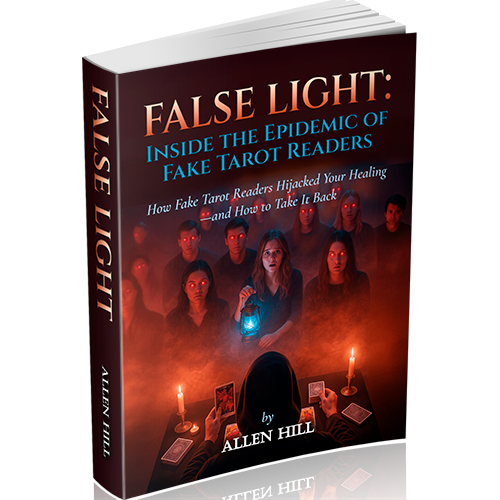
If they keep giving you hope—but your life never changes—there’s a reason.
