
What Makes A Tarot Reader Fake?…
Not everyone holding a tarot deck is practicing real tarot.
Fake tarot readers are not defined by whether they seem spiritual, confident, gifted, popular, or sincere.
A fake tarot reader is defined by whether they sell tarot as something it isn’t.
If a reader uses tarot as a window into fixed future events, secret feelings, hidden motives, guaranteed outcomes, or spiritual certainty, they’re not helping you see clearly.
They’re asking you to trust a fantasy you can’t verify.
Real tarot brings you back to yourself.
Fake tarot pulls you away from yourself.
That’s the difference.
The Short Version
A real tarot reader uses tarot as a mirror.
A fake tarot reader sells tarot as a window.
A real tarot reader helps you see patterns, choices, emotions, blocks, fears, options, and truths you may not be facing clearly.
A fake tarot reader claims to know what will happen, what someone else secretly feels, what Spirit has guaranteed, or what future outcome is already written.
That’s not a style difference.
That’s a different model of guidance.
One returns power to the viewer.
The other makes the reader, the cards, the future, Spirit, or someone else’s hidden feelings the authority.
That’s where the line is.
Why This Page Exists
The phrase fake tarot reader gets used a lot here.
It appears in False Light.
It appears in the directory.
It appears in Tarot Reader Integrity Reports.
It appears in red flag discussions, reader archetypes, and warnings about unsafe tarot guidance.
So it needs to be defined clearly.
Because fake tarot reader does not only mean obvious scammer.
It does not only mean someone stealing photos, pretending to be someone else, or sending fake DMs to sell readings.
Those are scams.
They matter.
But they’re not the whole problem.
The bigger problem is the reader who builds an entire platform on false authority.
The reader who claims tarot can do what tarot cannot responsibly do.
The reader who turns the cards into a prediction machine.
The reader who sells certainty where uncertainty exists.
That’s the kind of fake guidance this page is here to name.
A Fake Tarot Reader Is Not Always A Conscious Scammer
Some fake tarot readers know exactly what they’re doing.
Some don’t.
Some are deliberately manipulating people.
Some are repeating what they learned from other readers.
Some are audience-trained.
Some are algorithm-trained.
Some are emotionally unprocessed.
Some genuinely believe they’re helping.
But sincerity does not make the guidance real.
A reader can believe their own message and still be wrong.
A reader can care about their audience and still create dependency.
A reader can sound compassionate and still sell false certainty.
A reader can mean well and still train people to wait, chase, obsess, and outsource their knowing.
So the question is not only:
Does this reader have bad intentions?
The better question is:
What does this reader’s guidance actually do to the viewer?
That’s the line, and it’s what the Tarot Reader Integrity Reports Directory is built to examine.
The Real Line Is Mirror Vs Window
This is the simplest way to understand the difference.
Real tarot is a mirror.
Fake tarot is a window.
A mirror helps you see what’s already present.
A window claims to show you something outside your direct knowing.
A real tarot reader may help you see your own patterns, fears, desires, choices, blind spots, emotional loops, and next steps.
A fake tarot reader claims to show you someone else’s hidden feelings, the exact future, the secret plan, the spiritual outcome, or the guaranteed timeline.
A mirror brings you back into relationship with your own life.
A window pulls you into a story you can’t verify.
That’s why this distinction matters.
Tarot can be powerful as a mirror.
But when a reader sells it as a supernatural surveillance tool, they’ve crossed into fake guidance.
What Real Tarot Readers Do
A real tarot reader helps you see more clearly.
They don’t need to pretend they know everything.
They don’t need to sell certainty.
They don’t need to hijack your hope.
They don’t need to turn the cards into proof of what you already want to believe.
A real tarot reader may help you notice a pattern.
Name what you’re avoiding.
Understand your emotional response.
Separate hope from reality.
See where you’re giving your power away.
Ask better questions.
Consider grounded choices.
Come back to your own judgment.
A real tarot reader does not need to become the authority over your life.
The reading should sharpen your discernment.
Not replace it.
What Fake Tarot Readers Do
A fake tarot reader sells access to things they can’t actually know.
They may claim to know what someone secretly feels.
Whether someone is coming back.
When communication will happen.
What your future spouse will be like.
What your ex regrets.
What Spirit has planned.
What the universe is arranging.
What’s happening in the “5D.”
Whether reunion is guaranteed.
Whether someone is your twin flame.
Whether silence means love.
This kind of reading can feel comforting.
But comfort is not the same as truth.
A fake tarot reader turns uncertainty into performance.
They don’t just read the cards.
They build a world around the viewer’s hope.
And once the viewer starts living inside that world, it becomes harder to come back to reality.
Prediction-Based Tarot Is The Core Problem
This is the part that needs to be said plainly.
Future prediction is not real tarot.
It’s not the responsible use of tarot.
And it’s not harmless.
When a tarot reader claims they can predict the future, they’re not just making a bold statement.
They’re changing the viewer’s relationship to choice.
Now the viewer isn’t asking:
What do I know?
What do I need?
What can I choose?
What is reality showing me?
They’re asking:
When will it happen?
What did the reader say?
What if I mess up the prediction?
What if I walk away too soon?
What if the cards already know?
That’s how prediction-based tarot strips agency.
It makes the future feel fixed.
It makes the viewer passive.
It turns the reading into an authority.
And it gives the tarot reader a level of power no reader should have.
Mind-Reading Is Fake Guidance Too
Future prediction is not the only problem.
Mind-reading is part of fake tarot too.
A reader may not say, “I predict the future.”
But they may spend the whole reading claiming to know what someone else secretly thinks, feels, wants, regrets, fears, or plans.
That can sound like:
“They’re scared of this connection.”
“They want to come forward.”
“They’re watching you.”
“They know they messed up.”
“They’re hiding their feelings.”
“They’re about to confess.”
“They feel this bond too.”
The problem is not that human behavior can’t be interpreted.
The problem is when the reader presents speculation as spiritual fact.
A real tarot reading can explore patterns.
It can reflect possibilities.
It can help you ask better questions.
But when a reader starts narrating another person’s private inner world like they have direct access to it, that’s fake authority.
And fake authority is one of the engines of False Light in tarot.
Why Fake Tarot Feels So Real
Fake tarot often works because it gives the viewer something emotionally powerful.
Relief.
Hope.
Meaning.
Validation.
A story.
A reason to keep believing.
When someone is hurt, a reading that says “they still love you” can feel like medicine.
When someone is confused, a reading that explains the silence can feel like clarity.
When someone is grieving, a reading that says “it’s not over” can feel like rescue.
That’s why fake tarot is so dangerous.
It doesn’t always feel fake.
It often feels like the message you needed most.
But the question is not:
Did this make me feel better for a moment?
The question is:
Did this help me see reality more clearly after the relief wore off?
That’s where False Light hides.
It looks like healing.
It sounds like prophecy.
It creates a comforting fog that keeps people waiting, chasing, and emotionally hooked.
Popularity Doesn’t Make A Reader Real
Popular tarot readers can have hundreds of thousands of subscribers and still be selling fake guidance.
Views don’t prove integrity.
Comments don’t prove truth.
Aesthetic branding doesn’t prove responsibility.
Confidence doesn’t prove accuracy.
A soothing voice doesn’t prove clarity.
A reader can be popular because they’re helpful.
But a reader can also be popular because they know how to feed the emotional loop people are already stuck in.
If the viewer is desperate to hear “they’re coming back,” the algorithm will reward the reader who keeps saying it.
If the viewer wants signs, the algorithm will reward the reader who keeps creating them.
If the viewer wants certainty, the algorithm will reward the reader who sells it.
That’s why popularity can be misleading.
Sometimes the biggest channel is not the clearest channel.
Sometimes it’s just the most effective hook.
The Fake Tarot Reader Is Selling False Authority
The deeper issue is not the deck.
It’s authority.
A fake tarot reader positions themselves, the cards, Spirit, the universe, or divine timing as the authority over the viewer’s life.
The message becomes harder to question because it feels bigger than a normal opinion.
It’s not just:
“This is my interpretation.”
It becomes:
Spirit says.
The cards say.
The universe says.
Your guides say.
The energy says.
Divine timing says.
That language can make a message feel sacred even when it’s just speculation.
And once a reader claims spiritual authority, the viewer may feel guilty, afraid, or “low vibe” for questioning it.
Real tarot does not need that.
Real tarot can say:
Here’s what I see.
Here’s the pattern.
Here’s the mirror.
Now bring it back to your own life and decide what’s true.
Fake tarot needs you to believe the reader has access to something you don’t.
Real Guidance Returns Power
Real guidance returns power to the person receiving it.
False Light pulls that power away.
Real guidance says:
Look at what’s happening.
Trust what you know.
Notice the pattern.
Come back to your choices.
You don’t need to abandon yourself to keep hope alive.
False Light says:
Wait.
Trust the process.
They’re coming back.
This is divinely guided.
You just need another message.
You’re almost there.
That’s the difference.
One brings you back into your own life.
The other keeps you orbiting a fantasy.
Real Tarot Readers Can Still Be Spiritual
Calling out fake tarot does not mean tarot has to become cold, clinical, or stripped of meaning.
Real tarot can still be spiritual.
It can still be symbolic.
It can still be intuitive.
It can still be sacred.
It can still speak to the deeper layers of a person’s life.
The issue is not spirituality.
The issue is false authority.
A spiritual reading can still be grounded.
A symbolic reading can still be honest.
An intuitive reading can still respect uncertainty.
A compassionate reading can still refuse to feed fantasy.
A real reader does not have to abandon spiritual language.
They just need to stop using spiritual language to bypass reality.
That’s the difference.
What Real Tarot Guidance Sounds Like
Real tarot guidance may sound like this:
“This reading points to a pattern, not a fixed outcome.”
“The cards are bringing your attention back to your choices.”
“I can’t tell you what they’ll do, but I can help you look at what this situation is asking of you.”
“This may not be the answer you wanted, but it may be the truth that frees you.”
“Let’s look at what you can actually act on.”
“Don’t use this reading to avoid what you already know.”
“Your peace should not depend on someone else’s future behavior.”
“This is not about waiting for them. This is about coming back to yourself.”
That kind of guidance may not always give the viewer the emotional hit she wanted.
But it gives her something better.
Her power back.
What Fake Tarot Guidance Sounds Like
Fake tarot guidance may sound like this:
“They’re definitely coming back.”
“They’re afraid of how intense this connection is.”
“You’re in separation because this is part of the journey.”
“Your divine masculine is awakening.”
“They’re watching you.”
“They regret everything.”
“This was divinely orchestrated.”
“The universe is bringing this together.”
“They’re going to communicate soon.”
“The full truth is in the extended.”
Some of those lines may sound harmless by themselves.
But repeated over time, they can build an entire emotional reality.
The viewer starts living from the reading instead of reality.
That’s the danger.
Fake tarot doesn’t just give a message.
It gives the viewer a world to live inside.
Why Fake Tarot Keeps People Hooked
Fake tarot keeps people hooked because it rarely gives enough clarity to end the loop.
It gives relief.
Then uncertainty returns.
So the viewer watches again.
The next message gives more relief.
Then doubt returns again.
So the viewer searches again.
That cycle can become addictive.
Hope.
Relief.
Doubt.
Search.
Repeat.
A fake tarot reader may not consciously intend to create that loop.
But if their content depends on keeping viewers emotionally suspended, the result is the same.
The viewer becomes less grounded.
Less self-trusting.
Less able to choose.
More dependent on the next message.
That’s not guidance.
That’s dependency with candles around it.
What About Readers Who Mean Well?
This matters.
Because not every harmful reader is malicious.
Some readers are wounded.
Some are projecting.
Some are trying to help people through the same fantasy they haven’t escaped themselves.
Some learned from a tarot culture that already normalized prediction, twin flames, divine timing, and “what do they feel?” readings.
Some are simply giving the audience what gets clicks.
But meaning well does not erase impact.
A reader can mean well and still cause harm.
A reader can care and still mislead.
A reader can be sincere and still build dependency.
A reader can believe in their own predictions and still sell false certainty.
That’s why the focus has to stay on the guidance model.
Not just the reader’s personality.
Not just their intentions.
Not just whether they seem nice.
What does the reading train the viewer to believe, feel, and do?
That’s the question.
How This Connects To Tarot Reader Integrity Reports
Tarot Reader Integrity Reports are built to examine public tarot reader content for repeated guidance patterns.
Not vibes.
Not gossip.
Not whether the reader seems nice.
The reports look at what the reader repeatedly says, promises, implies, excuses, normalizes, or sells.
That matters because fake tarot usually reveals itself through repetition.
The same future predictions.
The same hidden-feelings claims.
The same spiritualized waiting.
The same twin flame language.
The same dopamine-hit titles.
The same extended-reading pressure.
The same viewer dependency.
The same loss of agency.
A Tarot Reader Integrity Report helps you see whether a reader’s content brings viewers back to reality, clarity, and choice…
Or deeper into False Light.
How This Connects To Tarot Reading Red Flags
Fake tarot readers usually reveal themselves through tarot red flags.
Not always one huge, obvious red flag.
Often through repeated patterns.
A reader who makes guaranteed predictions.
A reader who talks about twin flames like they’re real.
A reader who treats Spirit like a magic concierge.
A reader who invents details the cards don’t say.
A reader who uses dopamine-hit titles.
A reader who twists every card into something positive.
A reader who keeps people waiting instead of moving.
A reader who turns the reading into a sales funnel.
Those patterns matter because they show the reader’s operating model.
Are they using tarot as a mirror?
Or are they selling a fantasy window?
That’s what the red flags help reveal.
How This Connects To The Lighthouse Standard
The Lighthouse Standard is the minimum viewer-protection standard used in Tarot Reader Integrity Reports.
A reader does not pass the Lighthouse Standard just because they’re popular, comforting, spiritual, or sincere.
The question is whether their content protects viewer agency.
Does the reader support clarity?
Do they respect uncertainty?
Do they return power to the viewer?
Do they avoid dependency-building guidance?
Do they refuse to sell fake certainty?
Do they use tarot responsibly?
That’s why the real vs fake distinction matters.
A fake tarot reader fails at the level of the guidance model.
They may sound helpful.
They may feel comforting.
But if their work depends on prediction, false authority, hidden-feelings claims, and viewer dependency, they’re not meeting the standard real guidance should meet.
Real Doesn’t Mean You Hand Over Your Power
Even a real tarot reader should not become your authority.
A grounded reader can still be wrong.
A helpful reader can still miss something.
A sincere reader can still have blind spots.
That’s why the goal is not to find someone you can blindly trust.
The goal is to stop trusting blindly.
A real tarot reader should strengthen your discernment.
Not replace it.
They should help you come back to yourself.
Not make you more dependent on them.
So even when a reader seems grounded, ethical, and clear, keep your power with you.
That’s the whole point.
How To Use This While Browsing The Directory
When you open a tarot reader profile, don’t only ask:
Did they get a good score?
Ask:
Does this reader use tarot as a mirror or a window?
Do they return power to the viewer?
Do they sell certainty?
Do they make predictions?
Do they narrate someone else’s hidden feelings?
Do they spiritualize waiting?
Do they keep viewers focused on someone else’s future behavior?
Do they help people make grounded choices?
Do they make the viewer clearer?
Or do they make the viewer need another message?
That’s how to use this page.
Not as a label to throw around.
As a lens.
The Point Is Clarity, Not Drama
Calling a tarot reader fake is not about drama.
It’s not about ego.
It’s not about attacking everyone who reads differently.
It’s about naming the difference between guidance that helps and guidance that hooks.
Because the tarot space has hidden behind “take what resonates” for too long.
It has hidden behind vibes.
It has hidden behind “don’t judge.”
It has hidden behind spiritual language that makes people afraid to question what’s being sold to them.
But questioning guidance is not negative.
It’s necessary.
If a reading can’t survive discernment, it wasn’t guidance.
It was a spell made of hope, performance, and borrowed authority.
Real Tarot Gives You Back To Yourself
Real tarot does not need to predict your future to be powerful.
It does not need to narrate someone else’s hidden feelings.
It does not need to turn Spirit into a guarantee machine.
It does not need to keep you waiting for signs, messages, reunions, or divine timing.
Real tarot helps you see.
Fake tarot helps you escape.
Real tarot may challenge you.
Fake tarot usually sedates you.
Real tarot brings your choices back into the room.
Fake tarot keeps your power somewhere else.
That’s the difference.
And once you see it, you can’t unsee it.
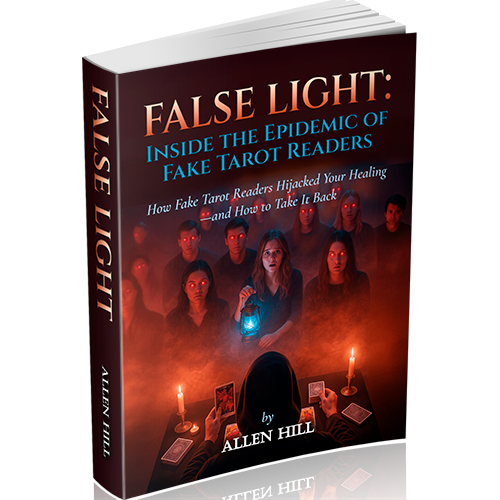
Want the deeper breakdown? Download False Light for free.
Is Your Favorite Tarot Reader Dangerous?
If they keep giving you hope—but your life never changes—there’s a reason.
Is Your Favorite Tarot Reader Dangerous?
If they keep giving you hope—but your life never changes—there’s a reason.
