
What Tarot Reader Profiles Are
A tarot reader profile is the viewer-facing guide to a tarot reader’s public YouTube tarot readings content, guidance patterns, risk level, and overall reader profile inside the directory.
It’s not just a shorter version of the report.
And it’s not a normal tarot reader review.
A Tarot Reader Integrity Report focuses on what was found in the analyzed content.
A tarot reader profile helps you understand the bigger picture.
What kind of guidance does this reader repeatedly offer?
What patterns show up across their content?
How might those patterns affect viewers?
Does the reader bring people back to clarity, choice, and self-trust?
Or do they keep people waiting, hoping, decoding, and coming back for more?
That’s what the profile is here to help you see.
The Short Version
A Tarot Reader Integrity Report is the audit.
A tarot reader profile is the viewer guide.
The report looks closely at the specific content reviewed.
The profile explains what those findings suggest about the reader’s public guidance style, channel behavior, red flag patterns, viewer risk, archetypes, and overall integrity picture.
That difference matters.
Because most people don’t just need raw findings.
They need to understand what those findings mean before they keep trusting a reader with their hope, heartbreak, choices, or spiritual beliefs.
Why Tarot Reader Profiles Exist
Most tarot reader reviews are based on opinion.
Someone liked the reading.
Someone didn’t.
Someone thought the reader was accurate.
Someone thought the reader was fake.
Someone felt seen.
Someone felt misled.
That kind of feedback can be useful, but it’s also limited.
A tarot reader profile is different.
It’s built to show repeated public content patterns.
Not just whether the reader seems nice.
Not just whether their readings feel comforting.
Not just whether the audience loves them.
The profile exists because tarot content can shape how viewers think, hope, wait, choose, and trust themselves.
And when a reader has influence over people’s emotional lives, their guidance patterns deserve a closer look.
The Profile Is Not The Same Thing As The Report
The report and the profile work together.
But they don’t do the same job.
A Tarot Reader Integrity Report is focused on the reviewed content.
It looks at what was found in the analyzed material.
The report documents the evidence, scoring, red flags, green flags, tactics, patterns, and findings from The Lighthouse Standard audit process.
A tarot reader profile translates those findings into a broader viewer-facing picture.
It may include the reader’s score, grade, risk classification, Lighthouse Standard result, channel context, archetype patterns, red flags, green flags, viewer impact, Mirror vs Window analysis, integrity gap, and consumer protection guidance.
The report answers:
What did the audit find?
The profile answers:
What does this mean for someone deciding whether to trust this reader?
That’s the difference.
Related: What Is The Lighthouse Standard?
What A Tarot Reader Profile Is Not
A tarot reader profile is not gossip.
It’s not a popularity contest.
It’s not based on whether the reader seems likable.
It’s not about whether the reader has a beautiful setup, a soothing voice, or a loyal comment section.
It’s not a claim to know the reader’s private motives.
It’s not a personal attack.
And it’s not meant to tell you who you’re “allowed” to watch.
The profile is about observable public patterns.
What does this reader repeatedly say?
What do they normalize?
What do they sell?
What kind of hope do they feed?
What kind of authority do they claim?
What kind of relationship with tarot do they train viewers to have?
That’s the point.
The Scoreboard Gives You The First Snapshot
The scoreboard is usually the first thing people notice.
That makes sense.
It gives you the quick version.
The Tarot Reader Integrity Score shows where the reader landed overall.
The grade gives that score an easy-to-understand frame.
The Lighthouse Standard result shows whether the reader met the minimum viewer-protection threshold.
The risk classification shows the level of concern raised by the profile and report findings.
But the score is only the doorway.
It’s not the whole profile.
A score can tell you where a reader landed.
The profile helps you understand why.
Don’t Stop At The Score
The score matters.
But don’t stop there.
Two readers can land near each other numerically and still create different kinds of risk.
One reader may be highly predictive.
Another may be emotionally soothing but dependency-building.
Another may use twin flame ideology.
Another may hide harmful messages behind soft spiritual language.
Another may have fewer extreme claims but a very strong pattern of keeping viewers suspended.
That’s why the tarot reader profile matters.
The score tells you the result.
The profile shows you the pattern.
And the pattern is where the truth usually lives.
Channel Context Shows The Size Of The Influence
Channel context helps you understand the reader’s public footprint.
It may show how visible the reader is, how established the channel appears to be, how much reach their content has, what kind of audience they’re speaking to, and how their content is positioned.
Why does that matter?
Because influence changes the stakes.
A harmful guidance pattern on a tiny channel still matters.
But a harmful guidance pattern by the most popular tarot readers – repeated to thousands, tens of thousands, or hundreds of thousands of viewers creates a bigger consumer-protection concern.
The bigger the reach, the more important the pattern becomes.
Stated Intent And Observed Pattern Are Not Always The Same
A reader may say they want to help.
They may say they’re here to heal people.
They may say their messages are divinely guided.
They may say their content is empowering.
They may even believe all of that.
But the profile looks at the pattern.
Does the content actually empower viewers?
Does it help them see clearly?
Does it bring them back to grounded choices?
Does it help them trust themselves?
Or does it keep them waiting, hoping, decoding, buying, watching, and searching for the next message?
Intent matters.
But impact matters too.
A tarot reader profile helps separate what a reader says their content is doing from what the content appears to train viewers to do.
The Integrity Gap Shows The Distance Between Image And Impact
The integrity gap is where the profile starts getting especially useful.
A tarot reader may have a soft image.
A spiritual brand.
A caring tone.
A devoted audience.
A beautiful aesthetic.
A message that feels safe.
But the actual content may still create dependency, false hope, spiritualized waiting, or emotional confusion.
That space between how the reader appears and what the content does is the integrity gap.
Sometimes the gap is small.
Sometimes it’s huge.
The tarot reader profile helps you see it.
Because false guidance doesn’t always look dark.
Sometimes it looks comforting.
Sometimes it looks sincere.
Sometimes it looks exactly like what you wanted to hear.
Related: Real Tarot Readers Vs Fake Tarot Readers
Reader Archetypes Show The Role The Reader Plays
Tarot Reader archetypes help summarize the repeated role a reader appears to play in the viewer’s emotional loop.
This is not about reducing a person to a label.
It’s about naming a pattern.
A reader may function as a Comfort Prophet.
Or a Fantasy Supplier.
Or a Sugar-Coated Shadow-Dodger.
Or a Twin Flame Priestess.
Or another False Light archetype.
The archetype helps you understand the flavor of the guidance.
Does this reader soothe?
Inflate hope?
Avoid hard truth?
Spiritualize dysfunction?
Perform certainty?
Turn pain into a destiny story?
Keep viewers emotionally suspended?
The archetype gives language to the role the content plays.
And once you can name the role, it becomes easier to see the pattern.
Red Flag Patterns Show Where Guidance Becomes Unsafe
Red flags are not random complaints.
They’re patterns that may weaken viewer agency, distort reality, feed false hope, spiritualize dysfunction, or build dependency.
A profile may highlight red flag patterns such as prediction certainty, twin flame ideology, spiritualized waiting, invented details, parasocial hooks, or sales-funnel pressure.
The point is not to panic over one phrase.
The point is to look at the pattern.
Does the reader repeatedly use tarot to return power to the viewer?
Or do they use tarot to make viewers more dependent on the next message?
That’s what red flag patterns help reveal.
Related: What Counts As A Red Flag In A Tarot Reading
Green Flags Show Where Guidance Protects The Viewer
Green flags matter too.
A tarot reader profile should not only show what’s wrong.
It should also show where a reader demonstrates viewer-protective patterns.
Green flags in tarot readings may include respecting uncertainty, avoiding guaranteed predictions, bringing the viewer back to their own choices, refusing to romanticize dysfunction, discouraging obsession, separating hope from reality, and encouraging grounded action.
They may also show where a reader avoids using tarot as a replacement for judgment.
Or where they refuse to pretend they know what can’t be known.
Green flags show where the reader’s content protects clarity instead of exploiting vulnerability.
Mirror Vs Window Shows The Reader’s Tarot Model
This may be one of the most important parts of the tarot reader profile.
Does the reader use tarot as a mirror?
Or do they use tarot as a window?
A mirror brings the viewer back to what’s happening inside their own life.
Their choices.
Their patterns.
Their fears.
Their boundaries.
Their next step.
A window claims to show the viewer what they can’t verify.
Someone else’s hidden feelings.
A fixed future.
A secret plan.
A spiritual timeline.
A guaranteed outcome.
A divine promise.
That difference changes everything.
A profile’s Mirror vs Window analysis helps viewers see whether the reader is using tarot to build agency or replace it.
Related: What Real Tarot Means In Tarot Reader Reviews
Viewer Risk Is About The Effect On The Person Watching
Viewer risk in tarot is not about whether the reader is likable.
It’s about what the content may do to someone who is emotionally vulnerable.
A viewer may already be heartbroken.
Waiting.
Obsessing.
Trying to decode silence.
Looking for signs.
Afraid to let go.
Attached to a spiritual explanation.
If a tarot reader repeatedly gives that viewer more false hope, more certainty, more waiting language, more spiritual excuses, or more hidden-feelings narratives, the risk goes up.
Because the viewer may leave the reading less able to trust what reality is already showing her.
That’s why viewer risk matters.
The question is not just:
Did the reading comfort her?
The better question is:
Did the reading make her clearer, freer, and more self-trusting afterward?
Related: What Viewer Agency Means In Tarot
The Profile Connects The Dots
A Tarot Reader Integrity Report is more focused.
It’s tied to the analyzed material.
A tarot reader profile can connect dots across the broader reader picture.
That may include how the reader positions themselves, how their channel presents its guidance, how the public-facing pattern fits with the report findings, how the reader’s score connects to viewer risk, how archetypes and red flags work together, and how the profile fits inside the wider directory.
That’s why profiles are valuable.
They’re not just shorter reports.
They’re a different kind of viewer tool.
The report shows the audit.
The profile helps you understand what that audit may mean in context.
Why Profiles Matter Before You Trust A Tarot Reader
People don’t just watch tarot for entertainment.
A lot of viewers watch when they’re confused, grieving, hopeful, anxious, lonely, heartbroken, or trying to decide what to do next.
That makes tarot content powerful.
And because it’s powerful, it deserves discernment.
Before you trust a tarot reader with your hope, your heartbreak, your decisions, your spiritual beliefs, or your sense of reality, it helps to know what kind of guidance they repeatedly offer.
Do they help people see?
Or do they keep people searching?
Do they clarify?
Or sedate?
Do they give language to reality?
Or build a fantasy around uncertainty?
A profile helps you look before you give your trust away.
How To Use A Profile As A Tool, Not A Discernment Substitute
A tarot reader profile is a tool.
It’s not a replacement for your own judgment.
Use it to ask better questions.
Use it to notice patterns.
Use it to slow down before trusting a reader again.
Use it to name what may have felt “off” but hard to explain.
But don’t use it to outsource your discernment.
The goal is not to make the profile your authority.
The goal is to help you become less vulnerable to false authority in the first place.
Related: How To Use The Tarot Reader Integrity Reports Directory
What To Look For When You Open A Tarot Reader Profile
When you open a tarot reader profile, don’t only look for the grade.
Look for the pattern.
Start with the score.
Then look at the Lighthouse Standard result.
Then look at the risk level.
Then look at the archetypes.
Then look at the red flags and green flags.
Then look at the Mirror vs Window analysis.
Then ask:
Does this match what I’ve felt while watching this reader?
Did their content make me clearer?
Or did it make me need another message?
Did I leave with more agency?
Or more hope to chase?
That’s how the tarot reader profiles become useful.
The Full Report Shows The Receipts
The profile helps you understand the bigger picture.
The report shows the deeper findings behind it.
Every tarot reader profile in this directory is connected to a Tarot Reader Integrity Report.
That matters because the profile is not floating on its own.
It’s built from the report data, the scoring system, the reader’s public YouTube tarot readings content patterns, and the consumer-protection analysis that comes out of the full review process.
The profile gives you the readable overview.
The report gives you the deeper breakdown.
So when you want the quick picture, start with the tarot reader review profile.
When you want to understand what was actually found, read the full integrity report.
Together, they show the pattern from two angles:
The profile helps you understand what it means.
The report shows you what it was based on.
Profiles Are The Heart Of The Tarot Reader Integrity Reports Directory
The Tarot Reader Integrity Reports Directory is not just a list of names.
The profile pages are where the directory becomes useful.
Each reader profile gives the viewer a way to look at a specific tarot reader’s public pattern.
Not as gossip.
Not as fandom.
Not as a vibe check.
As a consumer-protection tool.
The directory helps you find the reader.
The profile helps you understand the reader.
The report helps you see the deeper evidence behind the findings.
Together, they create the full pathway.
What A Profile Can And Can’t Tell You
A tarot reader profile can show repeated public patterns.
It can show risk signals.
It can summarize report findings.
It can explain archetypes, red flags, green flags, and viewer-agency concerns.
It can help you see whether a reader’s content functions more like a mirror or a window.
But a profile cannot tell you what to do with your life.
It cannot know the reader’s private motives.
It cannot replace your own discernment.
It cannot decide who you’re allowed to watch.
And it cannot do the work of trusting yourself for you.
That’s still yours.
The profile is here to support your clarity, not replace it.
The Point Is Viewer Protection
The point of a tarot reader profile is not drama.
It’s not punishment.
It’s not about starting fights in the tarot space.
It’s about viewer protection.
Because people deserve to know what kind of guidance they’re letting into their mind.
They deserve to know whether a reader’s public content repeatedly returns power to the viewer…
Or pulls that power away.
They deserve to know whether the comfort they’re receiving is actually helping them see clearly…
Or just keeping them emotionally suspended.
A profile makes the pattern easier to see.
And once the pattern is visible, the viewer has more choice.
Start With The Tarot Reader You Already Watch
The most useful profile is usually the one connected to a tarot reader you already know.
Not because you’re looking for permission to like them.
Not because you’re looking for a reason to hate them.
Because your own experience matters.
Open the profile.
Read the pattern.
Notice what lands.
Notice what makes you uncomfortable.
Notice what gives language to something you already felt.
Notice where you want to defend the reader before you’ve even finished reading.
That reaction may tell you something too.
You don’t have to decide everything today.
Just start by looking clearly.
If The Profile Makes Something Click
Sometimes a tarot reader profile gives language to something you already felt.
Maybe you didn’t know why a reader’s content left you anxious.
Maybe you didn’t know why the readings felt comforting in the moment but kept sending you back for more.
Maybe you didn’t know why a message felt spiritual, but somehow made you less able to trust yourself.
That’s exactly how False Light in tarot works.
It doesn’t always look fake.
It doesn’t always feel harmful.
It often feels like hope, comfort, confirmation, or healing.
Until you realize it’s been keeping you in the same loop.
That’s why the profile matters.
It helps you see the pattern before the pattern keeps pulling you back in.
You can download False Light for free here.
Is Your Favorite Tarot Reader Dangerous?
If they keep giving you hope—but your life never changes—there’s a reason.
Is Your Favorite Tarot Reader Dangerous?
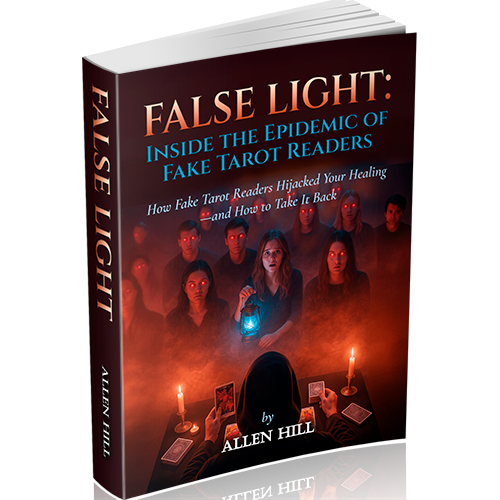
If they keep giving you hope—but your life never changes—there’s a reason.
